Sometimes the difference between a good image and a highly effective image has surprisingly little to do with photographic quality. Social proof in photography provides a fascinating example of how behavioural science can make an image substantially more persuasive and successful in achieving the desired outcome. An image can be beautifully composed, professionally lit and perfectly suited to a campaign, yet still underperform another image because of one seemingly insignificant behavioural difference.
A fascinating example comes from research involving a shopping centre that wanted to encourage visitors to enjoy lunch earlier, before the busy midday rush. Promotional posters were used to encourage shoppers to change their behaviour and eat earlier. One version featured a photograph of a person enjoying lunch and the text “Who says lunch has to be after 12?”.
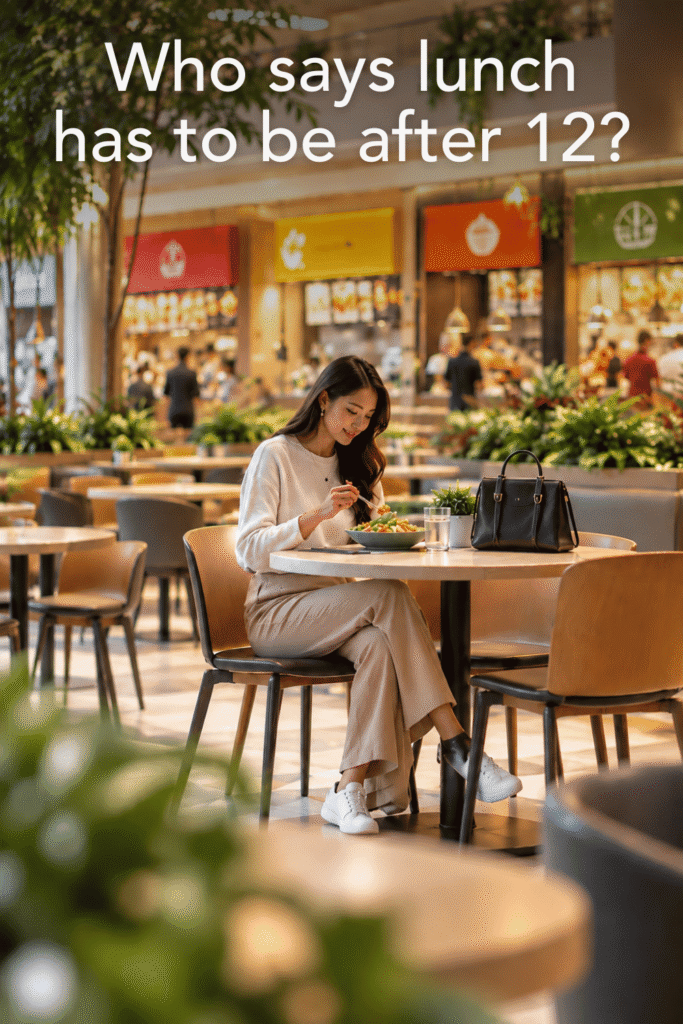
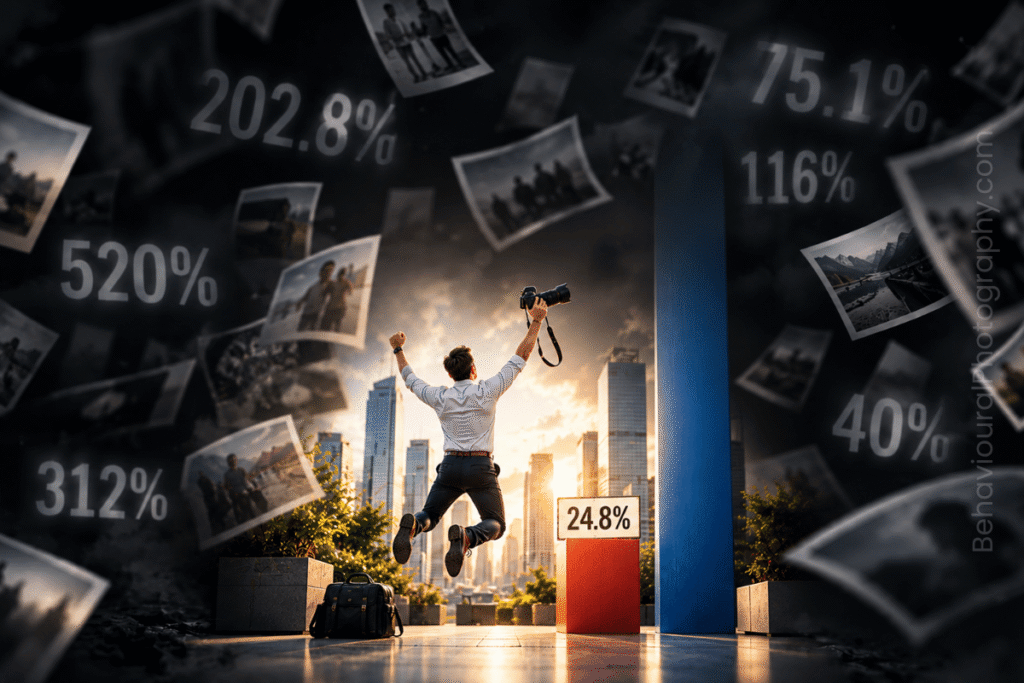
It worked. Compared with displaying no poster, the number of people arriving earlier increased by 24.8%. By almost any standard, that would be considered an excellent result. If you were the photographer, designer or marketer responsible for the campaign, you would probably be delighted.
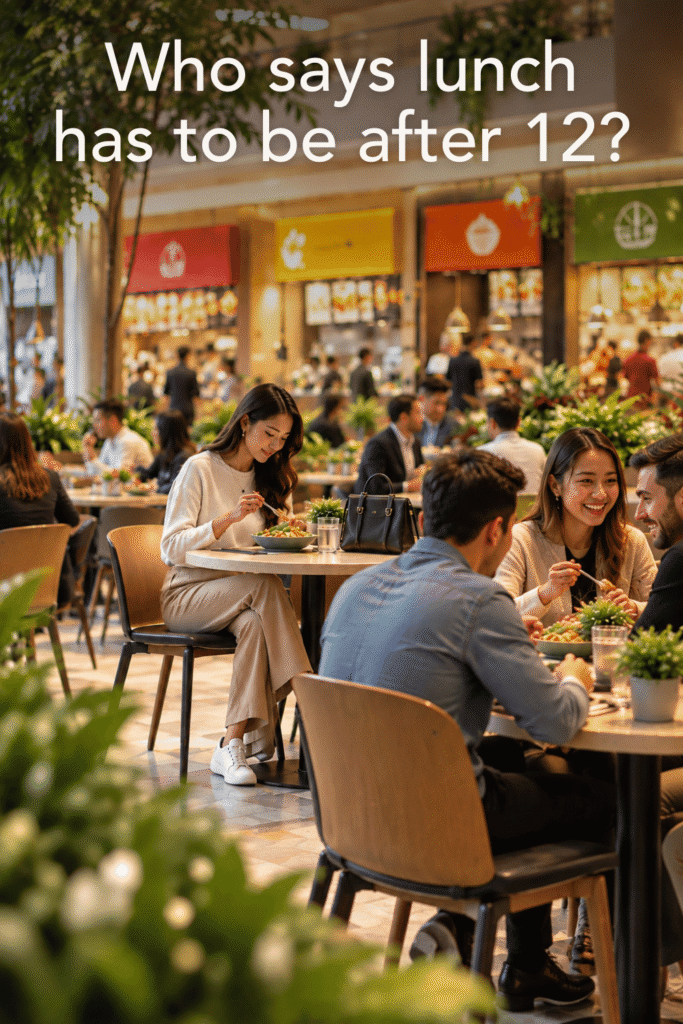
But the researchers tested another version. The wording remained the same, the offer remained the same and the design remained the same. Only the photograph changed.
This time, the number of people arriving earlier increased by 75.1%. In terms of the additional foot traffic generated above the baseline, the second image produced a 202.8% improvement over the first. (Dobson, 2015)
Can You Predict Which Image Was More Persuasive?
Before reading any further, take a moment to think about what you might change or what you might have suggested from the outset. The first photograph showed a person enjoying lunch. The message worked, producing a very respectable 24.8% improvement. What different photograph will make the same message substantially more persuasive?
You don’t need to change the headline, create a better offer or redesign the poster. What would you change about the image shoppers would see?
Once you know the answer, it seems remarkably simple. The second photograph showed multiple people enjoying lunch together. Predicting beforehand what would have produced greater effectiveness and more success for the client in this case, becomes considerably easier when you understand the behavioural science behind social proof in photography or behavioural photography in general.
What Is Social Proof in Photography?
Let’s unpack what happened.
Social Proof is a universal Principle of Persuasion describing our tendency to look to the behaviour of others when deciding what we should do ourselves, particularly when those others are numerous or similar to us, and when we are uncertain.
Social proof in photography applies this principle visually by showing other people already performing the behaviour we would like our audience to consider instead of telling people about it verbally or writing it down for people to read.
Social Proof was originally referred to as Consensus, and it provides us with an extraordinarily useful mental shortcut. Rather than investigating every decision from the beginning and considering all the facts present in the situation, we can observe what other people have already decided to do and use their behaviour as information. A photograph can therefore do considerably more than demonstrate what an action looks like. By showing that other people are already performing that action, the image can provide persuasive information about the behaviour itself.
This becomes particularly powerful when our audience is uncertain about what to do.
How Social Proof Influences Human Decision-Making
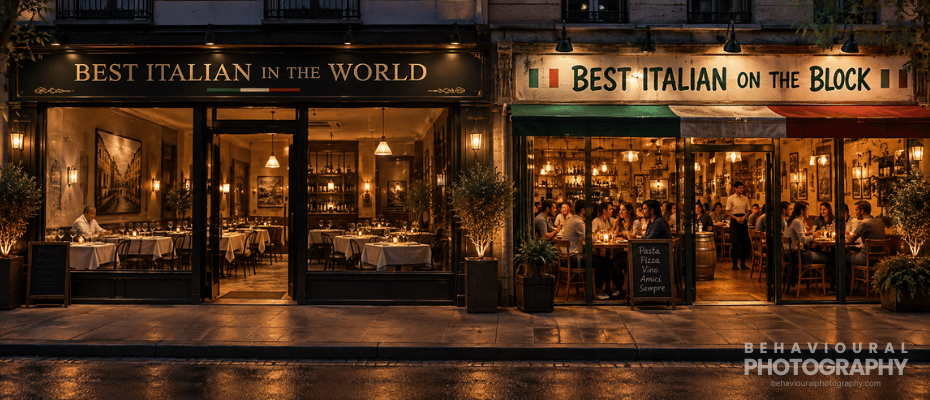
Imagine you are visiting an unfamiliar town and looking for somewhere to eat. You come across two restaurants next door to each other. One is completely empty, while the other is comfortably busy. Unless you have other information available, which restaurant feels like the safer choice?
You could investigate thoroughly. You could speak to neighbouring businesses or perhaps even contact the local council to discover whether there have been complaints about food poisoning. Given enough time and motivation, you could collect considerable information before making your decision. In reality, you’re hungry. You just want lunch.
Your brain therefore notices something much easier to process: other people have already made this decision. The customers sitting inside the busier restaurant provide a visual clue. Other people faced with essentially the same decision chose that restaurant, and their behaviour provides information about what might be a sensible choice for you.
This is precisely the kind of shortcut our fast, intuitive System 1 predominant decision-making part of our brain can use. Instead of investing considerable mental effort investigating the alternatives, the behaviour of other people can reduce uncertainty and help us reach a decision quickly. This is one reason visual social proof in photography (or any other means of visual communication, like videography, illustrations, AI-generated images) can be so useful: we can sometimes communicate persuasive information almost instantaneously, without requiring our audience to read or consciously analyse an argument.
Of course, social proof does not guarantee that the popular choice is the best choice. The empty restaurant could be wonderful. However, following the behaviour of others proves useful often enough that it has become an important part of how human beings navigate uncertain decisions.
Why Showing More People Can Strengthen Social Proof in Photography
Now we can return to our shopping-centre posters. Both photographs contained Social Proof because both showed someone already performing the desired behaviour. A shopper viewing the first poster saw another person enjoying an earlier lunch. The photograph therefore did more than demonstrate what the shopping centre wanted people to do; it provided a visual of another person already doing it.
The second photograph, however, introduced an important amplifier of Social Proof: Numerousness.
When we see one person perform a behaviour, their action provides us with some information. When we see multiple people performing the same behaviour, the social proof becomes stronger. It no longer appears to be merely one person’s choice. It begins to look like something people are doing.
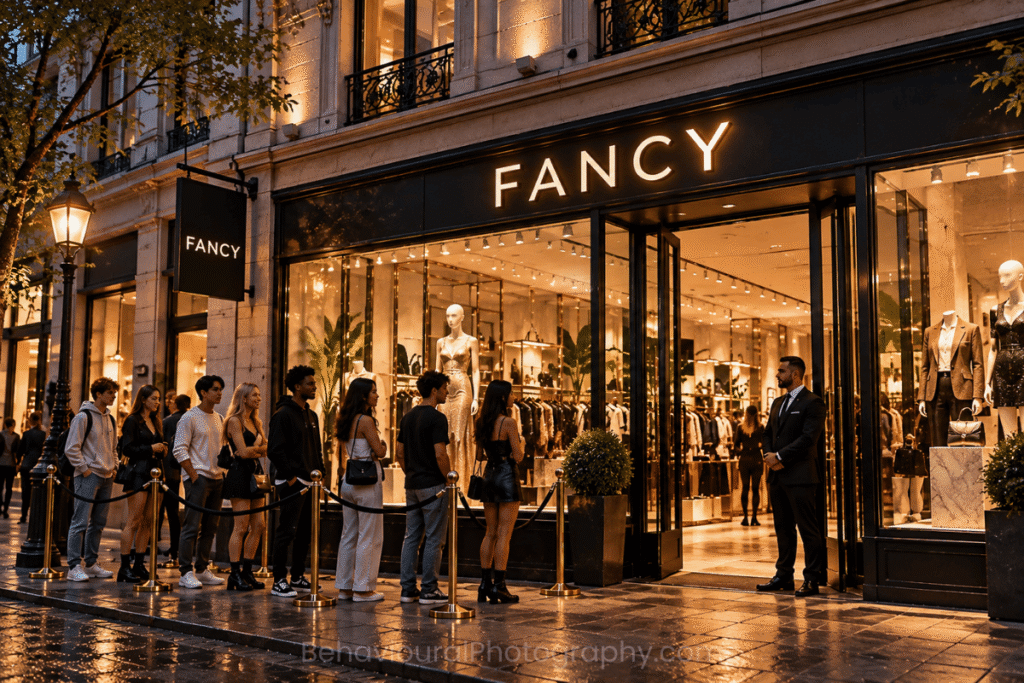
Research into queue choice demonstrates another interesting aspect of Social Proof. The number of people already waiting can itself provide information about the quality of what they are waiting for. Under certain conditions, researchers have shown that it can even be rational to disregard other information and join the longer of two queues, because the behaviour of those already waiting signals that they may know something we do not. (Veeraraghaven & Debo, 2008)
In other words, the behaviour of the crowd becomes part of the evidence we use to make our own decision. For anyone interested in using social proof in photography, that is an important distinction. Showing the desired behaviour is useful, but the number and type of people shown performing that behaviour can change the persuasive information communicated by the image considerably.
How Social Proof Made the Photograph 202.8% More Effective
This helps explain the dramatic difference between the two shopping-centre posters. The first photograph showed one person performing the desired behaviour and increased earlier lunch visits by 24.8%. The second showed multiple people performing that same behaviour and increased earlier visits by 75.1%.
Measured by the additional foot traffic generated above baseline, the photograph featuring multiple diners produced 202.8% more additional behavioural impact than the photograph featuring one diner.
The first photograph was therefore not a bad photograph. Quite the opposite: it demonstrably worked. But from a Behavioural Photography perspective, it was an underperforming Persuasive Asset because another image could perform the behavioural job substantially better.
That distinction matters. If we judged the first photograph only by its appearance—or even by the fact that it produced a 24.8% improvement—we might reasonably declare the campaign a success and never discover how much additional success continues to be wasted.
How to Use Social Proof in Photography and Visual Communication
For photographers, videographers, designers and marketers, applying social proof in photography introduces an important question when planning visual communication: Can we truthfully show other people already performing the behaviour we want our audience to consider?
If a university wants prospective students to imagine attending its campus, showing students actively participating in campus life may provide more useful behavioural information than photographing an empty or near-empty building. If a restaurant wants to communicate that it is a popular place to eat, photographs containing genuine customers may perform a different behavioural function from beautifully photographed plates, wine glasses and cutlery. If an organisation wants employees to adopt a particular behaviour, showing colleagues already performing that behaviour can do more than simply demonstrate the required action.
Numerousness is only one consideration and social proof has other amplifiers that a visual communication professional using behavioural photography will not want to miss to use to their and their client’s advantage.
Most importantly, Social Proof must be truthful. Using social proof in photography is not about manufacturing false popularity or creating the impression that customers, employees or communities are behaving in ways they are not. Behavioural Photography seeks to identify persuasive information that genuinely exists and communicate that information more effectively through imagery.
Creating More Persuasive Images With Behavioural Science
The shopping-centre experiment demonstrates why behavioural science deserves a place alongside composition, lighting, colour, storytelling and technical excellence when we create or select imagery. Understanding principles such as Social Proof gives photographers and other visual communication professionals another way to think about what an image needs to accomplish.
The difference between these two posters was remarkably small. The desired behaviour remained the same. The message remained the same. Yet changing the photograph from one person enjoying lunch to multiple people enjoying lunch dramatically changed the behavioural outcome and the value for the client.
This is at the heart of Behavioural Photography, a discipline that applies behavioural science to the creation and selection of images intended to support specific behavioural objectives. Social proof in photography is just one example of how understanding human decision-making can help us create images that do more than look good—they can be deliberately designed to support behaviour.
Rather than asking only how an image should look, Behavioural Photography asks a more important question:
What behaviour do we want this image to support?
Once we know the answer, the science of human decision-making can help us make better creative choices. Sometimes, as this example demonstrates, a relatively small change to an image can make a remarkably large difference to what people actually do and therefore the value it brings to us or our clients.
Learn More About the Science of Social Proof
Social Proof extends far beyond photographs of groups of people. Reviews, testimonials, customer numbers, popularity indicators, queues, user-generated content, survey results and many other forms of communication can provide information about what other people are already doing.
For a deeper exploration of the principle and how it can be applied ethically in communication and business, listen to the Ethical Persuasion Unlocked podcast episode on Social Proof. For a broader explanation of what Behavioural Photography is, check out our first blog post.