Have you ever noticed how a photograph of someone smiling can immediately make them seem more approachable, friendly or trustworthy? The psychology of smiling helps explain why something as simple as a facial expression can shape how we perceive others, how we feel about a business, and even the decisions we make.
For photographers, videographers, marketers, advertisers and business owners, this is far more than an interesting observation. Understanding how people respond to smiling faces can help us create visual communication that does more than look attractive. It can help build trust, strengthen connections and encourage people to take action.
A fascinating body of behavioural science explains why.
Why Are Smiling Faces So Powerful?
Human beings are remarkably sensitive to facial expressions. We can recognise happiness, anger, fear and other emotions in someone’s face, often almost instantly.
These expressions provide valuable social information. Before someone speaks, we can start forming impressions of whether they seem friendly, welcoming, confident, threatening or uninterested.
A smile is particularly interesting because it can communicate several things at once. It may suggest happiness, friendliness, openness and positive feelings towards the person observing it.

Imagine visiting two business websites offering essentially the same service. Both have professional designs, similar pricing and comparable qualifications. One features a photograph of a company team member or owner looking serious and reserved. The other shows the same person smiling warmly towards the camera.

Which person would you feel more comfortable approaching?
Your answer may depend on the circumstances, but a smiling photo could create a more favourable first impression. This is where the psychology of smiling becomes commercially valuable.
A photograph can start shaping someone’s feelings about a person or organisation before they read a single sentence or hear a single word.

The Psychology of Smiling and the Science of Liking
One of the most useful explanations comes from the science of ethical persuasion. Dr Robert Cialdini identified liking as one of the universal principles of persuasion. Put simply, we are generally more willing to agree with requests from people we like.
Several factors contribute to liking, including similarity, familiarity and the perception that another person likes us. Smiling can help communicate that last factor.
When someone smiles warmly towards us, we may interpret the expression as a sign of friendliness or positive regard. Even in a photograph, that smile can help create a sense of human connection.
Research by Burgoon and colleagues (1984) examined how nonverbal behaviours influence interpersonal impressions. Their findings showed that smiling, along with behaviours such as eye contact and leaning forward, could communicate greater attraction, intimacy and trust. Interestingly, some of those same behaviours, without a smile, could convey greater dominance and control.
Think about the implications for visual communication. A photograph showing someone looking directly into the camera with a serious expression may communicate confidence or authority. However, adding a warm smile could shift the impression toward friendliness and approachability. Neither expression is necessarily wrong. The important question is:
What response we want the photograph to encourage at the moment it’s seen, taking into account where it sits in the communication of the behavioural journey.

Can Smiling Faces Build Trust in Business?
Trust plays an enormous role in commercial decision-making, particularly when customers cannot personally inspect a product, meet a service provider or fully evaluate what they are being offered.
Consider someone booking accommodation online.
They may examine photographs of the property, read the description, compare prices and check previous guest reviews. However, if the accommodation is privately hosted, they may also see a photograph of the person offering it. That photograph then provides more information.
- Does the host appear approachable?
- Would the prospective guest feel comfortable contacting them or having discussions with them?
- Would they act reasonably if there was a problem?
- Given their access to the accommodation, would we feel safe there?
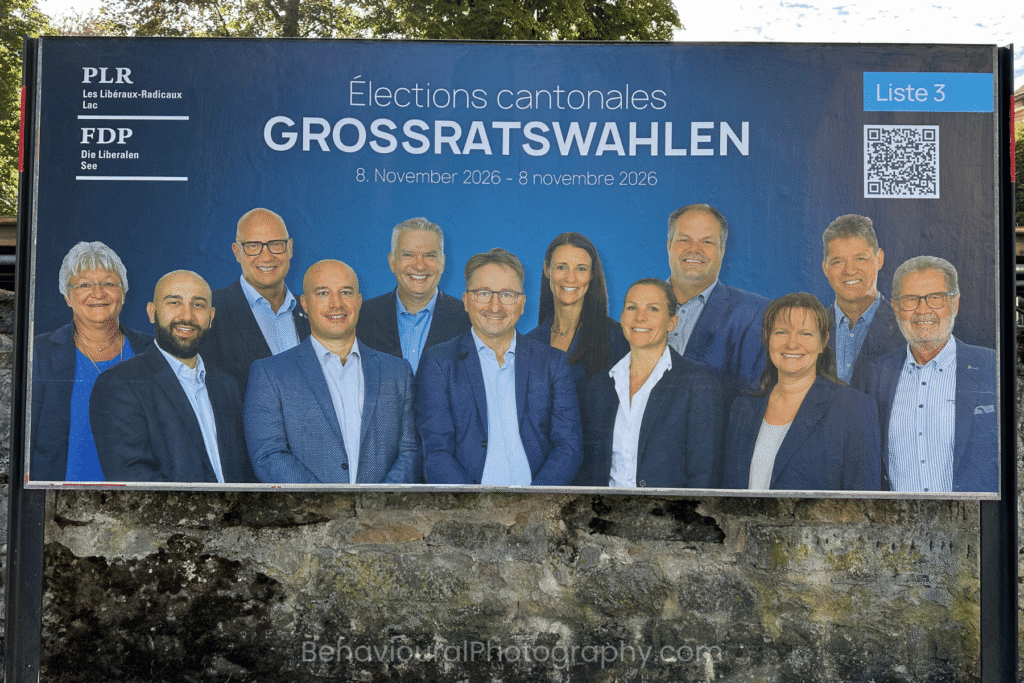
An important question, therefore, is whether the image helps to create a favourable impression. For example, look at the following image, which I saw while in Switzerland. It is for the upcoming Grand Council elections and features what appears to be a group of candidates standing for election to the cantonal parliament.
Zoom in on each candidate. They are all smiling, but I’d like you to look at each and realise what most of these images are signalling to you. Is it capability, trust, strength, or awkwardness? How many do you think captured the impression the candidate would like potential voters to notice? Did the photographer do a good job? Will this cost the PLR/FDP votes?
Research into online accommodation and an experiment involved 524 people. Positive facial expressions in host profile photographs on Airbnb increased both intention to trust and intention to book compared with neutral expressions (Banerjee et al., 2022).
A smiling face may provide a valuable and much-desired reassuring social cue. For a photographer creating portraits for a hospitality business, this distinction is valuable. The objective may not simply be to make the host look professional. It may be to help prospective guests feel sufficiently comfortable to enquire or book.
The psychology of smiling is not limited to photography and can be used in videography, illustrations, AI-generated imagery and elsewhere.
The Psychology of Smiling at Customers as They Enter a Store
Sometimes we enter a store or bank and are greeted by someone who seems placed there just to welcome customers. I’ve seen them at banks, large consumer goods stores, make-up retailers, and restaurants. Maybe you’d wonder if that is such a good use of their time. What might be going on is that the store management knows a little about the psychology of smiling.
- First, research shows that being greeted at the door when you enter increases the average purchase price.
- Second, if the person smiles as they welcome you, some research suggests this will increase customers’ pleasure, which in turn improves satisfaction with their experience while visiting the business. (Otterbring, 2017)
All of a sudden, that person standing there, smiling and greeting you as you enter, no longer feels like a waste of time and money. It’s a calculated investment, and those who fail to use the psychology of smiling at customers as they enter their stores may be wasting success. Certainly, when a store isn’t busy and there is a surplus of staff, assigning one person to welcome people at the door can easily increase results from the fewer clients present.

How Smiling Faces Influence Advertising and Marketing
Look through advertisements for healthcare, hospitality, education, professional services or consumer products, and you will quickly notice how frequently smiling faces appear. Advertisers use them for a reason.
Smiling people can help create a positive emotional atmosphere around a product, service or brand. They can also communicate what the advertiser wants the audience to expect from the experience.
- A photograph of someone smiling while enjoying a meal communicates more than the food’s appearance. It suggests enjoyment of it.
- A smiling customer receiving assistance from an employee may communicate friendliness and satisfaction.
- A photograph of a happy family enjoying a holiday can help prospective travellers imagine the experience they hope to have themselves.
In each case, the facial expression adds information that words alone may struggle to communicate as quickly.
However, an important distinction exists between showing a smiling person and creating a behaviourally effective image. The smile must support the communication’s purpose.
For example, an advertisement for a relaxing holiday might benefit from expressions of happiness and contentment. An advertisement discussing a serious medical condition may require empathy and reassurance rather than enthusiastic smiles.
We must determine which expression will best support the message and the desired behaviour.

Genuine Smiles Versus Posed Smiles
Not all smiles look the same. Some appear spontaneous and natural, while others seem carefully arranged for the camera. Researchers have long examined differences between genuine expressions of enjoyment and deliberately produced smiles. One frequently discussed distinction involves the muscles around the eyes.
Smiles associated with genuine enjoyment often involve both the mouth and the muscles surrounding the eyes. These are commonly called Duchenne smiles, named after the French neurologist Guillaume Duchenne. (Ekman, Davidson & Friesen, 1990)
For commercial photography, the practical lesson is simple.
A natural smile that fits the situation may communicate warmth more effectively than one that looks forced or disconnected from the surroundings.
This is particularly relevant when photographing employees, business owners, healthcare professionals or people who are uncomfortable in front of a camera. Rather than simply instructing someone to smile, a photographer might create a relaxed atmosphere, encourage conversation or capture a moment of genuine amusement. The resulting photograph may communicate a very different impression.
The Psychology of Smiling in Professional Photography
Understanding the psychology of smiling changes how we approach capturing or creating imagery.
Traditionally, a photographer or videographer may ask a client whether they prefer to be captured with a serious expression or a smiling one. The decision might be based largely on personal preference, appearance or the style of the photograph.
Behavioural Photography introduces another consideration:
What should the viewer think, feel or do after seeing this image?
Imagine photographing a team of physiotherapists. Some photographs may need to communicate expertise, competence and professionalism. Others may need to make nervous prospective patients feel welcome and comfortable about booking their first appointment.
A serious expression might suit one purpose, while a warm smile might work better for another.
The same applies to photographs of financial advisers, consultants, salespeople, educators, medical professionals and business leaders.
A single portrait doesn’t need to perform every communication task. This creates an opportunity for photographers to capture several facial expressions or moods during the same session that can be used at any time according to their intended behavioural purpose
Instead of delivering only a set of attractive headshots, the photographer begins creating a library of valuable visual communication assets.
When Should You Use Smiling Faces in Images?
The most useful question is not whether smiling photographs are generally better than serious photographs. It is whether a smile helps achieve the particular perception or behaviour the communication seeks to produce in the observer.
Consider a few situations:
- Building connection/approachability: A smiling portrait of a business owner may help prospective customers feel more appreciated and more comfortable to make contact.
- Creating reassurance: A friendly expression from a healthcare professional may help reduce anxiety before an initial appointment.
- Communicating enjoyment: Images of smiling customers can help viewers understand and anticipate the positive experience associated with a product or service (anticipatory enthusiasm).
- Supporting professionalism: A confident but friendly expression may help balance competence with approachability.
However, in some circumstances, a smile can weaken the intended message. A photograph addressing grief, workplace health risks, financial hardship or a serious social issue may require an entirely different expression.
This is why understanding the psychology of smiling is more useful than simply following a rule that smiling imagery of people is always preferable. The best facial expression is the one that helps the image perform its intended job.
From Attractive Photographs to Persuasive Assets
Most organisations invest in professional photography because they want their communication to achieve something. They want more enquiries, greater trust, stronger customer relationships, more applications, more donations or increased sales. Yet organisations often select photographs primarily because they look attractive, match the brand or appeal to the personal preferences of the decision-makers.
Behavioural Photography offers another approach. It applies behavioural science to creating and selecting images intended to support specific behavioural objectives.
Rather than asking only what an image should look like, we begin by asking what behaviour the image should support.
- A smiling portrait might help establish connection.
- Another expression might communicate authority.
- A photograph showing a customer enjoying an experience might help reassure prospective buyers.
Each image can perform a different behavioural function. Once we understand those functions, we can deliberately create and select photographs that support the organisation’s objectives.
This is the difference between simply producing visual content and creating what I call Persuasive Assets. An individual smiling in different ways that support different behaviours or feelings in the observer can therefore become separate persuasive assets, labelled and tagged well, ready for use at any time in the future.
The Takeaway: A Smile Is More Than an Expression
The psychology of smiling reveals something important about visual communication. Small details in an image can influence how people perceive others, how comfortable they feel and how they respond to a message.
A smile may communicate warmth, friendliness and positive feelings. In appropriate circumstances, those impressions can help establish the connection and trust that make people more comfortable taking the next step. In other situations, it can impact customer pleasure and satisfaction with their overall experience.
For photographers and other visual communication professionals, this creates an opportunity to offer clients something more valuable than attractive imagery.
We need to understand the behavioural science behind the images we create and use that knowledge to help organisations communicate more effectively. The next time you photograph someone, don’t simply ask whether they should smile. Ask yourself what the photograph needs to achieve because the most valuable photograph isn’t necessarily the one that looks best.
It’s the one that gives your audience the best opportunity to respond in the way the communication intended.