A Behavioural Photography Lesson
Have you ever noticed yourself looking in a particular direction simply because somebody else was looking there? Someone on the street suddenly looks towards the sky, and before you have consciously decided to do anything, you find yourself looking up too. Someone across the room turns their attention towards the doorway, and your attention follows.
It happens remarkably naturally.
Where other people look provides us with information about where something potentially important might be happening.

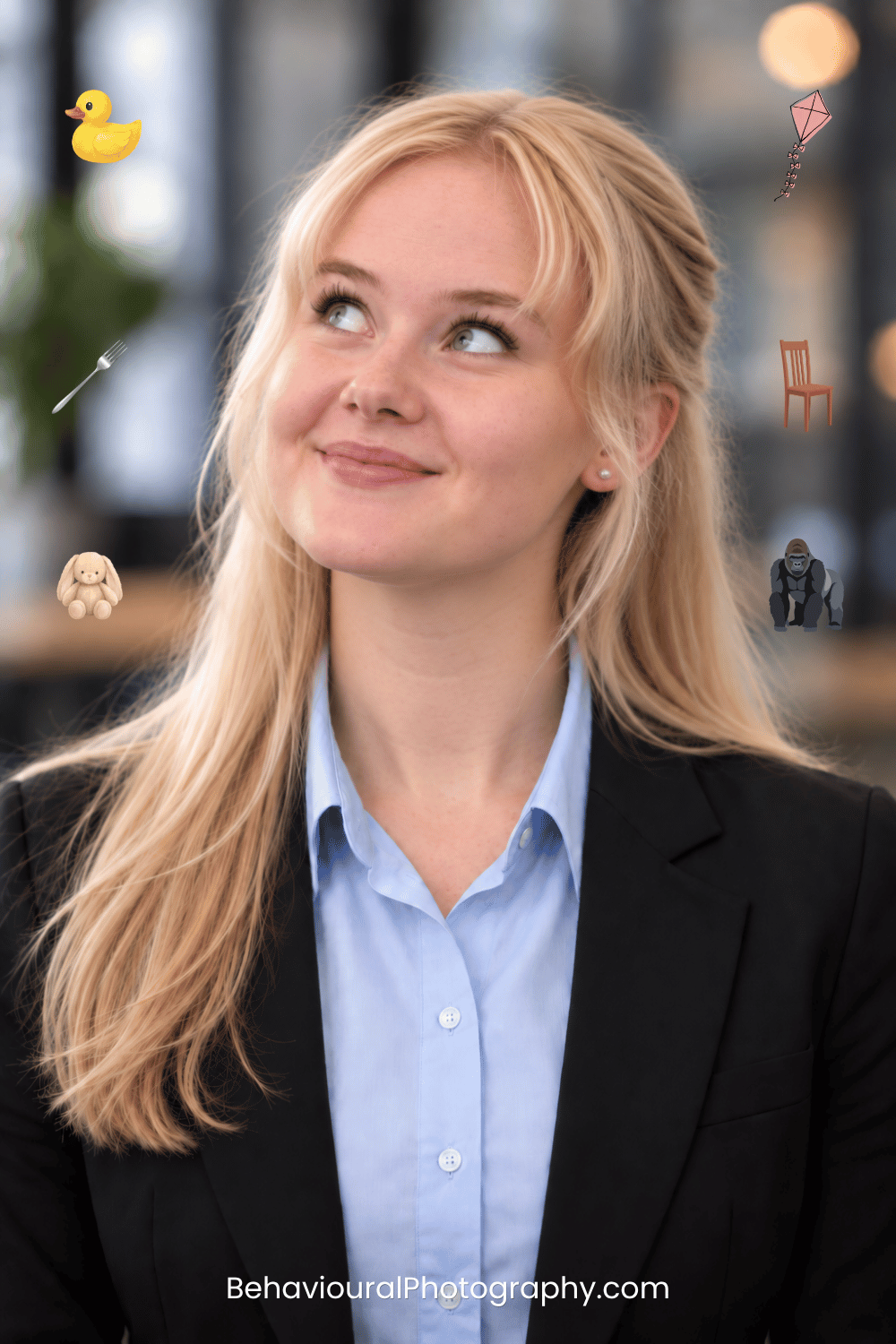



Did you play? – If you did, you may have spotted 3 items more readily than others? The duck, the plane and the plant. You were more likely to miss the laptop, the mountains, the book, the pen, the bus, the backpack, the phone, the dive mask, the calculator, the bicycle, the fork, the bunny toy, the kite, the chair, and the black gorilla.
Our attention is sensitive to the direction of another person’s gaze, and that simple piece of human psychology has, for those who know how to use it, fascinating implications for photography, advertising, websites, presentations and visual communication.
It is known as gaze cueing.
And once you understand it, you may never look at commercial imagery quite the same way again.
What is gaze cueing?
Gaze cueing is the tendency for another person’s direction of gaze to influence where we direct our own attention.
Researchers have studied the effect for decades. In experimental studies, participants are typically shown a face looking in a particular direction before another object or target appears. People tend to respond more quickly when that target appears in the direction indicated by the person’s gaze. A major review of gaze-cueing research describes eye gaze as an important source of information about where another person’s attention is directed. (Frischen, Bayliss & Tipper, 2007)
More recently, a meta-analysis examined 423 gaze-cueing effects and found reliable evidence that other people’s gaze directs observers’ attention across a wide range of experimental conditions. Interestingly for visual creators, the effect was found with photographs of real faces, computer-generated faces and schematic faces. (McKay et al., 2021)
That last point is particularly interesting for Behavioural Photography.
It suggests that we are not limited to traditional photography. The principle can potentially be incorporated into photographs, illustrations, cartoons, AI-generated imagery, animation and video.
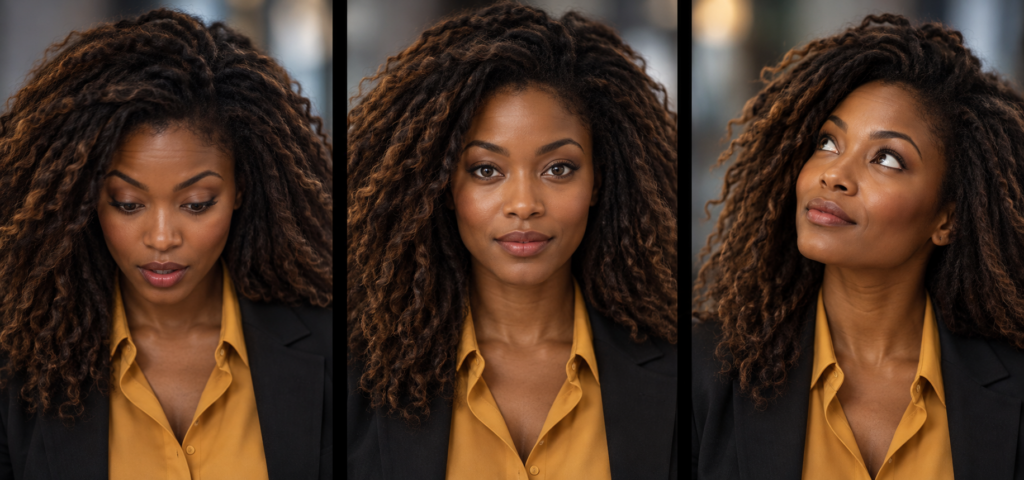
You looked at the images above. Depending on which country you’re from, you’ll read left to right and tend to look at the image on the left first. If you’re Arabic, this will be the opposite.
Even though you know perfectly well that these are simply images, you may have noticed what happened when you looked at the woman looking down. It urged you to look down as well. The same lady looking at you had no such effect, and perhaps you looked at her longer. Perhaps the strongest urge to follow her gaze was when you looked at the far-right image where she is looking top-left because more eye white made her ‘looking away’ more obvious.
Your eyes became more interested in discovering:
What is she looking at?
That question is enormously useful and valuable in visual communication.
How gaze cueing directs attention in photography
A photograph doesn’t just attract attention. It can direct it.
Faces are naturally interesting visual elements. But from a Behavioural Photography perspective, we can go further than simply asking whether including a person will make an image more engaging.
We can ask:
Where do we want the viewer to look next?
Imagine a website with a photograph of a person beside an important headline.
There are several ways we might photograph that person.
- They could look directly into the camera.
- They could look away from the headline.
- Or they could look towards it.
Aesthetically, all three photographs might be excellent.
Behaviourally, however, they may not perform the same job.
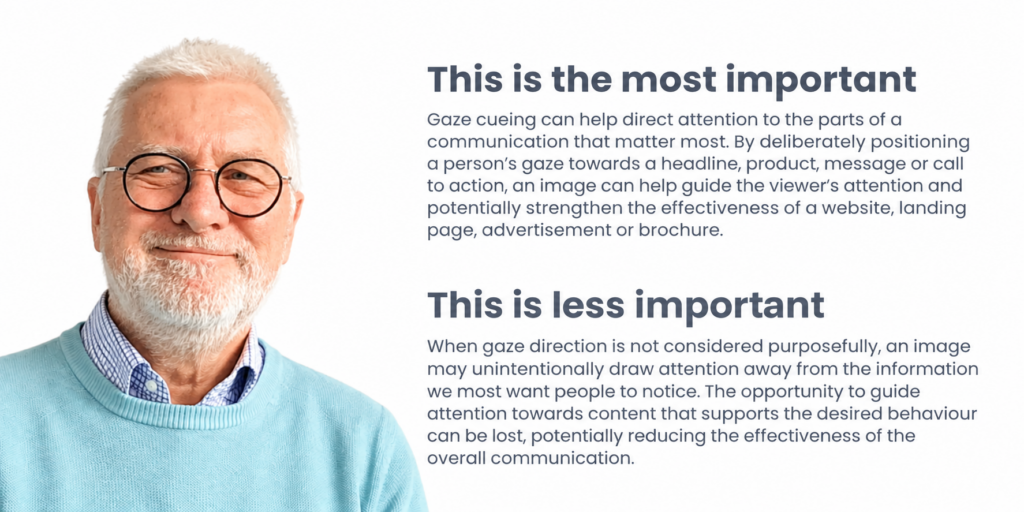
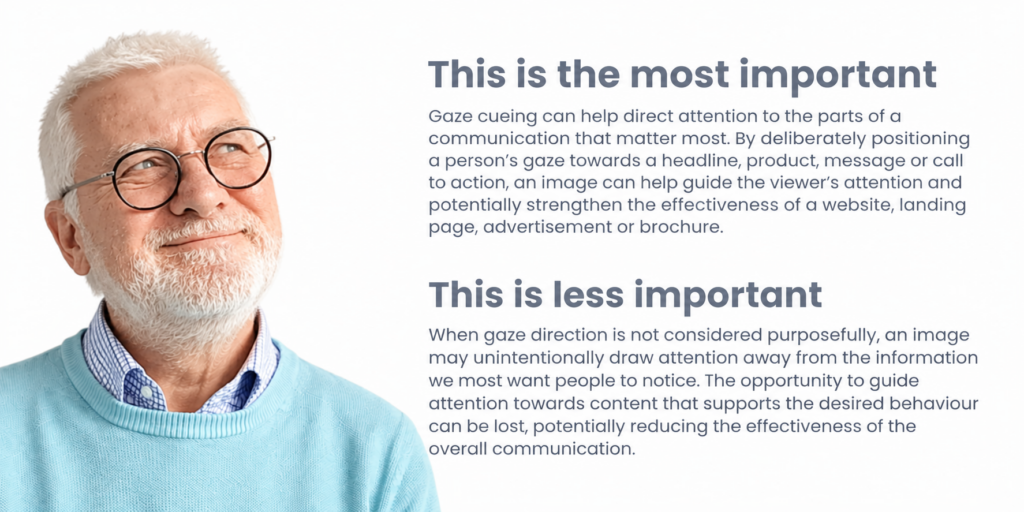
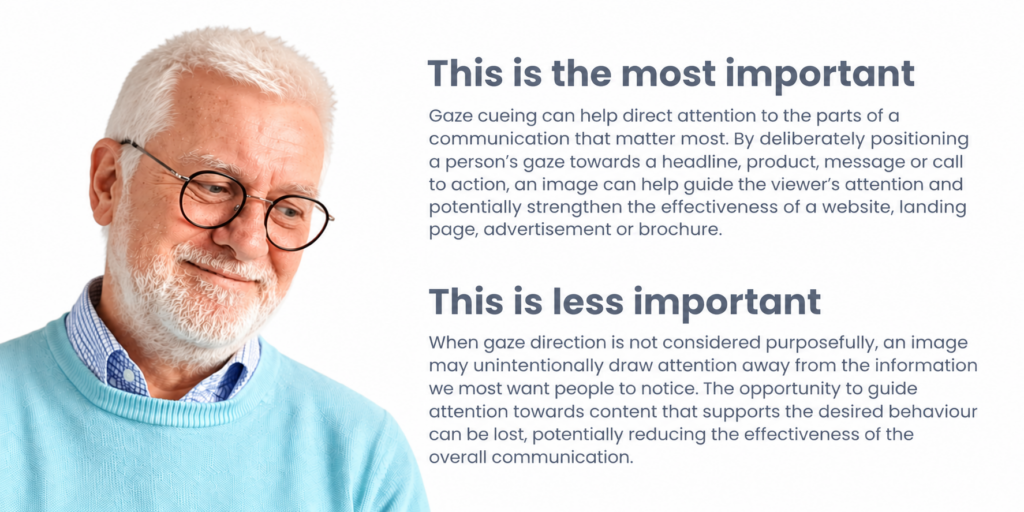
If the person’s gaze leads towards the headline, their eyes become part of the visual architecture of the page.
The photograph is no longer simply decoration:
It is helping direct attention.
This distinction sits at the heart of Behavioural Photography. Rather than beginning only with the question What should this image show?, we begin by asking What behaviour do we want this image to support?
Sometimes the behavioural objective of an image is to create trust or credibility. Sometimes it is to explain something. Sometimes it is to reassure or reduce uncertainty.
And sometimes its job is simply:
Look here.
Gaze cueing in advertising and marketing
The commercial implications of gaze cueing are more than theoretical. In a 2017 eye-tracking study, researchers examined how people responded to online banner advertisements containing human faces. Some faces looked towards the advertised product; others looked away from it.
When the face looked towards the product, participants were more likely to look at the product area themselves.
The researchers also found an effect on purchase intention: participants reported greater intention to buy the product when it had previously appeared alongside a face looking towards it, although gaze direction did not significantly change how attractive they judged the product itself to be. (Palcu et al., 2017)
That distinction is worth paying attention to.
Gaze cueing isn’t magic.
A person’s eyes cannot turn an unattractive offer into an attractive one, nor should we expect one psychological mechanism to determine an entire purchasing decision.
What gaze can do is help influence where attention travels.
And in commercial communication, that can be extremely valuable.
If your audience doesn’t notice an important headline, product, form, button or piece of information, it has very little opportunity to influence their subsequent behaviour and it may mean ‘game over’.
Direct Gaze vs averted gaze: how they influence attention
Look at me — now look over there.
There is another useful distinction when photographing people:
Direct gaze and directional gaze can perform different jobs.
A person looking directly into the camera establishes eye contact with the observer. That can make the face itself particularly important within the composition. But what if we want the viewer’s attention somewhere else? That is where averted gaze becomes useful. The person might look towards:
- a headline;
- a product;
- a call-to-action;
- a form;
- a button;
- another person;
- an important feature of an image;
- or even empty space where text will later be placed.
This gives designers and photographers an interesting sequence to consider:
Capture attention → redirect attention.
In video and animation, we can make this even more explicit. A person might initially look towards the viewer and then shift their gaze towards the information we want noticed next. The photograph, illustration or video subject effectively becomes a subtle visual guide.
How to use gaze cueing in a photoshoot
Here is where a small amount of behavioural knowledge can create a disproportionately useful asset. Suppose you are photographing the managing director of a company. You capture the traditional portraits: smiling at the camera, serious expression, standing, seated, perhaps a few different backgrounds.
Before finishing, capture a few more.
Ask them to look:
left … right … slightly upwards … slightly downwards.
And leave generous copy space in those directions.
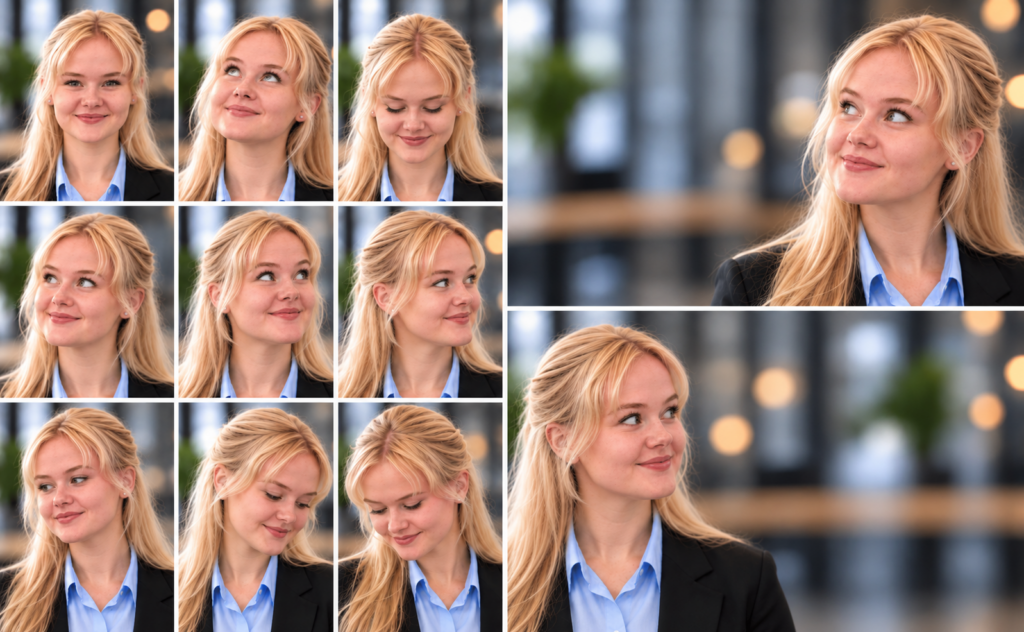
Those additional photographs may take only minutes to create. But six months later, when the marketing team needs a website banner with a headline on the left, they suddenly have an image in which the managing director naturally looks towards that headline. When they need a LinkedIn graphic with text on the right, they have another. When a presentation needs attention directed towards a statistic above the speaker’s photograph, another asset already exists.
This is why Behavioural Photography encourages organisations and visual professionals to think beyond individual photographs and begin building libraries of Persuasive Assets.
Gaze cueing beyond photography
It isn’t only photography. One of the particularly useful characteristics of gaze cueing is that it can be used in many kinds of visual communication.
- A cartoon character can look towards the headline.
- An illustrated person can look towards a diagram.
- An AI-generated businessperson can look towards the empty space reserved for copy.
- A person in a video can turn their attention towards a product.
- A character in an animation can glance towards the button we want the viewer to notice.
Research suggests that the gaze-cueing effect is not restricted to photographs of real faces; a large meta-analysis did not find the effect to be reliably dependent on whether the cue was a real face, computer-generated face or schematic face. (McKay et al., 2021)
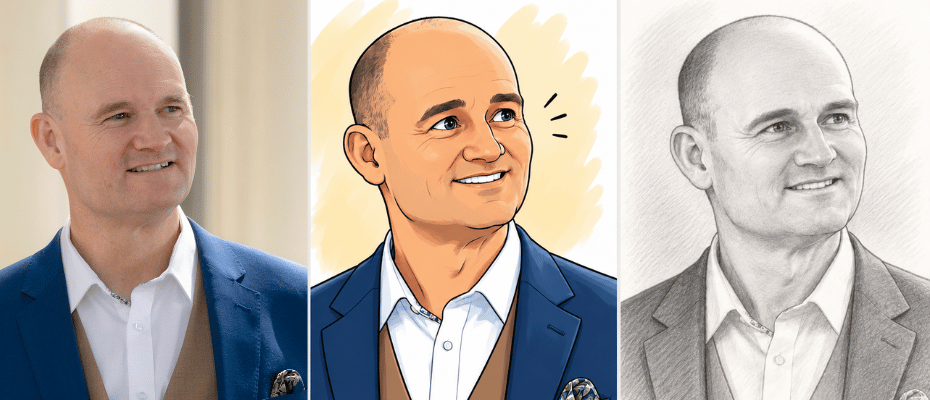
That makes gaze direction something worth considering whenever a human or human-like face appears in visual communication.
How unintended gaze direction can misdirect attention
Perhaps the most important lesson, however, is not that we should deliberately use gaze cueing. It is that we may already be using it accidentally.
Imagine spending thousands of dollars developing a website.
You have carefully written the headline.
You’ve tested the call-to-action.
You’ve chosen the right photograph.
And then the person in that photograph is staring towards the edge of the screen. Their gaze may be subtly encouraging the viewer to look in exactly the direction where there is nothing useful to see.
The image may be beautiful. Technically, it may be flawless.
But behaviourally, we should at least ask whether it is helping the communication achieve its objective.
This is an important distinction because every image communicates something. As the Behavioural Photography framework puts it, the more useful question is whether the image communicates the right thing for the situation in which it is being used.
How to identify gaze cueing in visual communication
The next time you look at a website, advertisement, brochure, presentation or social-media graphic containing a person, pay more attention to where the person is looking. Don’t look only at the person.
Look at where they are looking and then ask yourself:
Where did my eyes go next?
If their gaze directs you towards the most important information in the communication, that image may be doing more work than you previously realised. If their gaze leads you away from the message, towards empty space or even towards the edge of the page, there may be an opportunity to improve it.
And when you next plan a photoshoot, illustration or AI-generated image, add one more question to the creative brief:
Where do I want my audience to look first — and where do I want them to look next?
That is the difference between simply placing an image into communication and deliberately creating an image to support behaviour. And that is Behavioural Photography.