How to Stand Out as a Photographer: From Visual Creator to Behavioural Adviser
There are hundreds of thousands of professional photographers around the world. Add videographers, graphic designers, illustrators and the rapidly growing number of people creating imagery with artificial intelligence, and the number of professionals competing to produce visual content becomes enormous. At the same time, creating visually impressive imagery is becoming easier. Cameras continue to improve, smartphones can produce images that would once have required expensive professional equipment, editing software can transform photographs in seconds, and artificial intelligence can now create remarkably convincing photographs, illustrations and video without a camera being involved at all.
None of this means craftsmanship has become unimportant. Exceptional photography and videography still require skill, judgement, creativity and experience. However, it does raise an increasingly important question for anyone trying to build a successful career in visual communication: how do you stand out as a photographer when so many other professionals can also produce excellent images?
The usual advice is familiar. Develop a distinctive style. Find a niche. Build a stronger brand. Improve your portfolio. Promote yourself more effectively on social media. Provide exceptional customer service. Buy better equipment. All of these things can help, but your competitors are hearing exactly the same advice.
You may have never heard of this before, but there is another way to differentiate yourself that relatively few visual professionals have explored. A skill based on decades of scientific research that will set you apart, increase your value and create loyal, value-based relationships with your clients: understanding and knowing how to use behavioural science within the images you create.
Your Client Doesn’t Really Want an Image
Imagine a client contacts you and asks for photographs for a new website. It would be perfectly reasonable to start discussing the usual things: the number of images required, locations, lighting, clothing, style, composition, timing and budget. However, there is a more important question that should come first: what does the client actually want those images to achieve?
The answer is rarely that they simply want photographs (or a video or a cartoon or a drawing). The photographs are a means to an end. Often, the potential client describes that in terms of the end result their communication is meant to achieve. A landing page may have as its aim to get visitors to buy something, register for something or book an appointment. A social media post or brochure may aim to generate inquiry. But all these outcomes depend on the same thing: behaviour.
While everyone may know that images make us look professional or make communication more visually appealing, too many people don’t know there is a whole psychology behind how imagery can perform specific tasks. Actually, they have an amazing power because the eye is drawn to them so quickly and can influence what the observer feels, thinks and does before a word is read or heard. Images can support specific behavioural functions that contribute to achieving the end goal.
Perhaps the client wants prospective customers to trust them enough to read more of their brochure or landing page. They may want visitors to pay attention to key information, believe a claim, surrender their contact details to book an appointment. These are all behavioural steps on a behavioural journey, guiding them from the very second they observe the communication, to exposing themselves to the rest of the communication and eventually applying for a position, donating to a cause, visiting a location or purchasing a product.
Ultimately, an organisation wants behaviour, and in communication, from one moment to the next, the visitor is (or ought to be) guided through a behavioural journey through text and images that were not picked at random but used available science to optimise the outcome.
Once we recognise that, the visual creator’s role can change dramatically, becoming an exceptional, value-driven way to stand out as a photographer, videographer, graphic or web designer, or other visual content professional. Instead of asking only, What images would you like me to create?, we can begin asking a very different question that will make us unique:
What behaviour do we want these images to support?
That is the question at the heart of Behavioural Photography.
How to Stand Out as a Photographer When Everyone Promises Quality
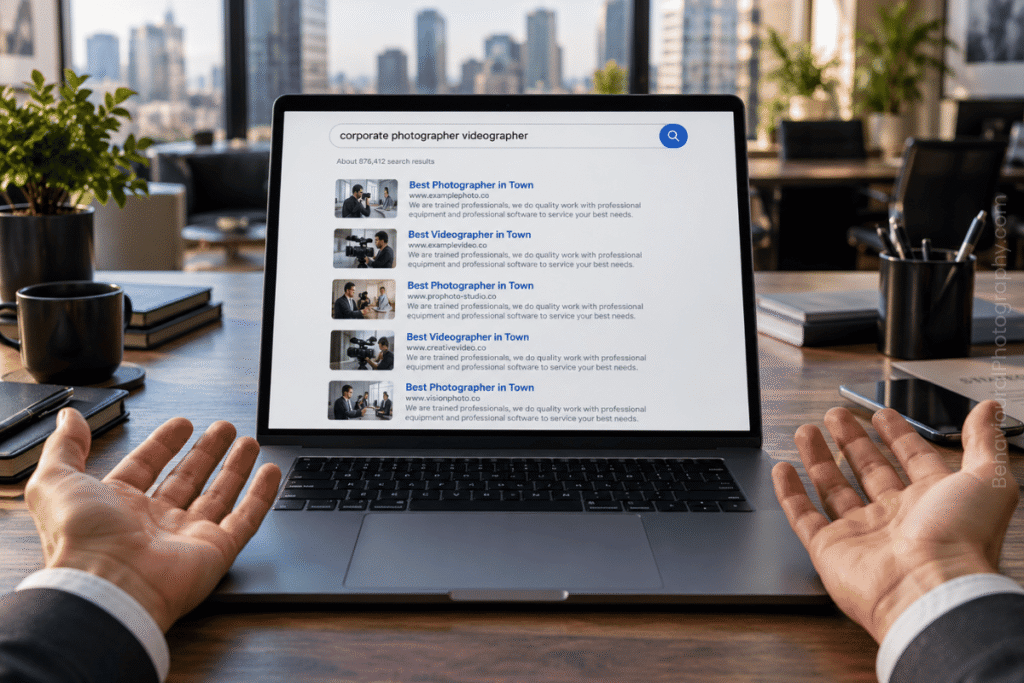
Take a moment to look at how photographers and videographers commonly promote themselves. You’ll find plenty of references to quality, creativity, professional equipment, years of experience, attention to detail, great service and an ability to capture the perfect moment. There is nothing wrong with any of those claims. The problem is that when everybody makes them, they become increasingly difficult to use as a meaningful point of difference. This makes it difficult to land new clients, but even those who have used you in the past may be easily tempted to try someone else.
If you want to know how to stand out as a photographer, it may therefore be useful to stop looking only at how you can produce a better image and start asking what additional expertise you can bring to the client. What value can you bring to the table that many of your competitors don’t? What conversation can you have that they cannot? What can you help a client achieve beyond delivering attractive imagery?
Behavioural Photography provides a logical and powerful answer. Instead of competing solely on the ability to produce visually impressive imagery, you can develop expertise in how imagery influences attention, perception, trust, understanding and behaviour. You can begin explaining not only how you will create an image, but why particular images may be more effective than others.
Suddenly, the conversation is no longer simply about photography. It is about results that you now seem to be uniquely capable of helping a client achieve.

Beautiful Images Are Not Necessarily Effective Images
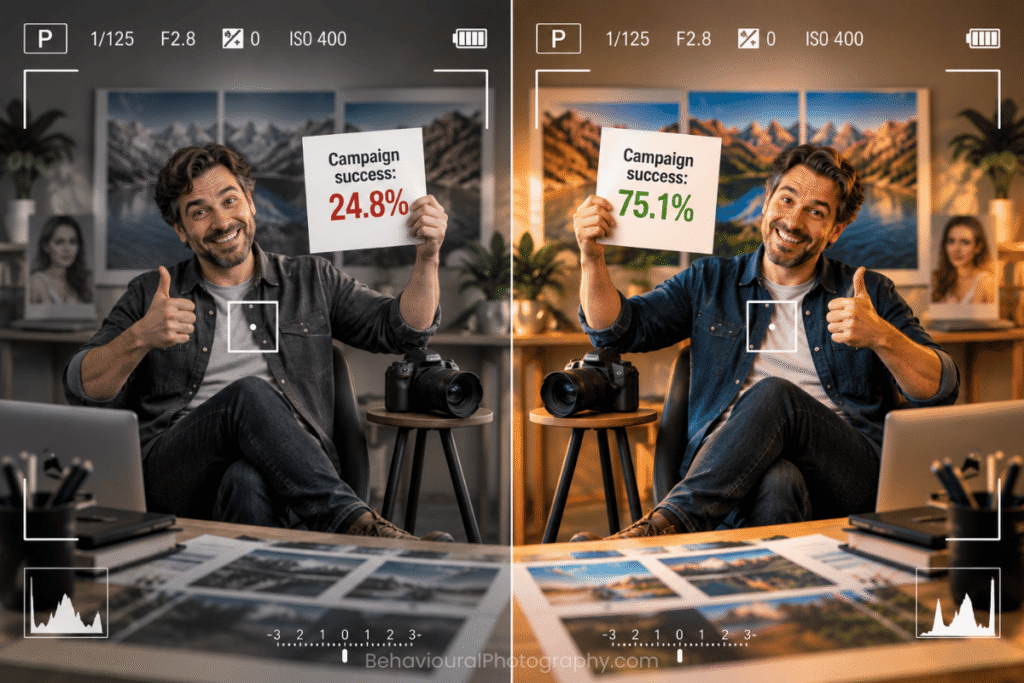
This distinction matters because two equally attractive images can produce very different behavioural outcomes. One of the studies I discuss in Behavioural Photography involved posters designed to encourage people visiting a shopping centre to eat lunch earlier. The wording and design remained the same, while the researchers changed the image. One version increased the desired behaviour by 24.8%, while another increased it by 75.1%. The difference (202.8%) was not due to better lighting, sharper focus or more expensive equipment. It was a difference in the behavioural information contained within the image.
That is an extraordinary idea for anyone working in visual communication. An image can be beautifully composed, technically excellent and fully satisfy the client’s brief, and everyone involved could be happy with the results, yet still substantially underperform another image that could reasonably have been created if the available science had been used.
The problem is that if nobody involved understands the behavioural science, nobody knows what they are missing. In a business, the consequence may be lost enquiries or sales. But what if you were asked to contribute to a campaign encouraging adherence to workplace safety procedures, seeking to reduce violence in the home, or encouraging someone experiencing suicidal thoughts to seek help? Suddenly, underperformance has consequences that extend far beyond revenue. When the behaviour we are trying to support affects people’s safety, health or wellbeing, getting the visual communication right becomes considerably more important.
Your client cares deeply about achieving the results that are able to be achieved within a situation. Those professionals who can help achieve the best outcomes, based on science, will stand out as a photographer or other visual professional.
Someone in Your Market Will Become the Behavioural Photography Expert
There is another side to this opportunity that is worth considering. While the science behind it is tried and tested, Behavioural Photography is still a new discipline we’re introducing to professionals, which means that in most markets there is unlikely to be an established photographer, videographer or visual creator already recognised as the local specialist in applying behavioural science to imagery.
That will not necessarily remain the case.
At some point, photographers and other visual professionals will begin adding this knowledge to their existing expertise. Someone in your city, region or perhaps your country may become known as the person who understands how to create imagery with scientifically informed behavioural purpose. They may be the photographer invited into meetings before the creative brief is written, the person marketing teams contact when they want to understand what their imagery should achieve, or the professional who is invited to speak at industry events about their behavioural expertise.
There are two ways to go. You can be one of the professionals who develops this expertise early and helps establish what Behavioural Photography looks like within your market, or you can wait until somebody else has demonstrated its value and then begin trying to catch up.
This is not about abandoning the skills that made you a photographer. Craftsmanship will always matter. It is about recognising that as high-quality image creation becomes more accessible, additional expertise becomes necessary to stay ahead or stand out. Behavioural Photography adds another layer of expertise—understanding what visual communication can help people think, feel and do.
So if you are wondering how to stand out as a photographer, consider not only what would make your work different today. Consider what expertise you would like to be known for five years from now.
What If You Know Something Your Client Doesn’t?
Imagine meeting a prospective client and explaining that you don’t simply create attractive images; you also study how imagery can influence attention, trust, understanding, reassurance, credibility and action. You can explain:
- why the direction in which a person is looking may influence where the viewer looks next,
- why the number of people performing an action can affect perceptions of what is normal or popular and how that is a subconscious decision trigger for people in every culture
- why legitimate indicators of expertise can increase credibility, or
- why an image can unintentionally direct attention away from the very message it was supposed to support.
For many clients, this may be a completely different conversation from the ones they are accustomed to having with photographers. You are introducing them to a science they may not have known existed and, perhaps more importantly, making them aware of opportunities they may currently be losing because their imagery was created without considering how people actually make decisions.
This does not require telling a client that everything they have been doing is wrong. They may start to question that on their own and ask you to investigate and suggest improvements. But the big opportunity to stand out from others is to demonstrate that there is another layer of science-backed thinking that ought to be part of the creative process, and that they shouldn’t do without it.
There may be dozens or hundreds of professionals in your market capable of producing excellent imagery. There are likely to be far fewer who can sit with a client and discuss not only what an image should look like, but what behavioural objective it should support and why particular visual choices may make that outcome more or less likely.
That is a genuine point of difference that adds value to the relationship.
AI Can Create an Image. But Who Decides What the Image Should Do?
Artificial intelligence makes this distinction even more important. AI is becoming extraordinarily capable at producing visual content. Given an appropriate prompt, it can create a corporate office, a smiling customer, an illustration, a product environment or an advertising concept in seconds. Generating an image, however, is not the same as diagnosing the behavioural problem that image needs to solve.
AI can certainly assist with behavioural analysis, and its ability to do so will continue to improve. The greater professional opportunity lies in understanding the client’s wider situation: investigating where customers are hesitating, recognising whether a website needs more reassurance rather than more attention, understanding how imagery fits into the sales process, and identifying which behavioural mechanisms are appropriate to use. Somebody needs to ask the right questions, understand the context and translate that understanding into an appropriate visual strategy.
The opportunity, therefore, is not necessarily to compete against AI. It is to develop expertise that allows you to use photography, video, illustration, design and AI more intelligently. As the technical production of imagery becomes increasingly accessible, understanding what should be created and what psychological mechanisms can maximise its effectiveness will become an increasingly valuable professional skill.
How Behavioural Photography Changes the Creative Brief
Traditionally, many visual professionals enter a project relatively late. A business decides what it wants, marketing develops the campaign, a web designer creates the structure, someone prepares a brief, and only then is the photographer, videographer, illustrator or image creator asked to produce the visual content.
Behavioural Photography creates the possibility of moving much further upstream.
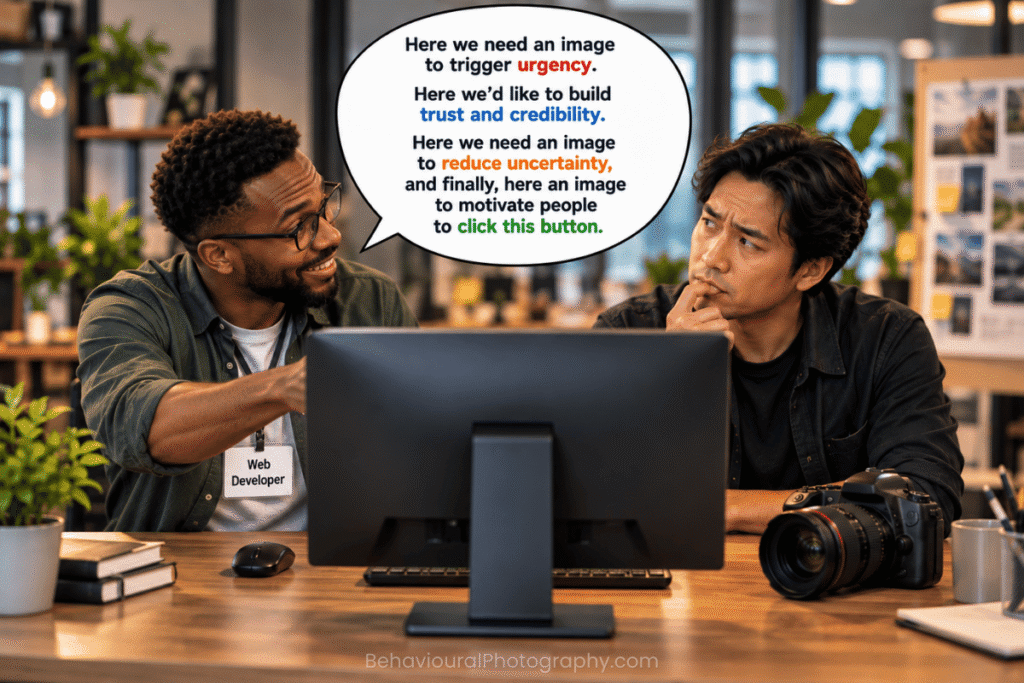
If you understand the science of human decision-making, there is a reason to involve you before the brief has been finalised. Instead of merely receiving instructions, you can help determine what the instructions should be. What behaviour are we trying to encourage at each step in the behavioural journey?
- What does someone need to think, feel or believe before they will take that final action that success depends on?
- Where might uncertainty occur?
- What needs to attract attention?
- Where is credibility particularly important?
- What visual evidence could reassure people?
- What imagery might help people understand what happens next?
Questions such as these can reveal visual requirements that nobody had previously considered. The web designer may understand websites exceptionally well, the advertising agency may understand campaigns, the sales department understands customers, and the photographer understands photography. However, if none of them has studied the behavioural science behind human decision-making, the visual professional who has may become the person who brings that missing expertise to the table.
That is a very different position from waiting for someone to tell you which photographs to take. Or having another visual professional explain to you a science that affects what you should be creating, and you having to admit you know nothing about it.
From Visual Creator to Behavioural Adviser
This is where the professional role itself begins to change. You are no longer valuable only because you know how to operate the camera, compose an image, light a subject or edit the finished result. You are becoming valuable because you can contribute to deciding what should be created in the first place.
That shift can also change when you are brought into a project. Photographers and videographers are often among the last professionals contacted, after many important communication decisions have already been made. The website has been designed, the advertising concept approved, the sales material planned and spaces have effectively been left for the imagery.
A Behavioural Adviser has a reason to be involved earlier. If the advertising department, web designer or sales team is not familiar with persuasion science and human decision-making, your expertise can contribute before the creative direction has been finalised. Rather than simply fulfilling the brief, you can help improve it.
One Photoshoot Can Create Far More Value
Suppose six employees have already been brought together for a corporate photoshoot. Traditionally, you might capture the team photograph, individual portraits and the other images specified in the brief. A Behavioural Photographer can see additional opportunities while those people, the location and the equipment are already available.
- Could you create images designed to communicate warmth and Connection?
- Could you capture genuine interactions that provide Social Proof?
- Could you create variations in which people look or gesture in different directions so those images can later direct attention towards headlines and calls to action?
- Are there legitimate indicators of expertise that could be photographed to reinforce Authority and credibility?
With relatively little additional production time, the client may be able to acquire a much more versatile collection of persuasive assets for future behavioural needs, which can be considerably more efficient than organising another production later.
Instead of simply building a folder of photographs, the client can begin developing a Persuasive Asset Library: a collection of imagery deliberately created and organised according to the behavioural jobs those images can perform.
Suddenly, the discussion is not about selling the client more photographs. It is about helping them get greater value from the opportunity already in front of them.
How to Stand Out as a Photographer by Creating More Client Value
This can substantially change the scope of the relationship. One assignment may reveal assets that are missing in another part of the organisation. Discussions with marketing, sales, recruitment or customer service may uncover completely different behavioural objectives that visual communication is currently not, but could, support.
A photographer may initially have been commissioned to create website imagery, for example, but during the behavioural planning conversation, it may become apparent that the sales team lacks imagery that reinforces expertise, the recruitment team needs visual assets that communicate culture and belonging, and the marketing department has no suitable images designed to direct attention towards calls to action, which is all undermining the success they could be having.
These are not invented needs created to sell additional photography. They are communication needs that may already exist but have never been identified because nobody has previously looked at the organisation’s imagery through a behavioural lens.
If you are exploring how to stand out as a photographer, this distinction is important. Being different is useful, but being more valuable is considerably more powerful.
Build a Relationship Instead of Completing a Job
Visual creators often complete an assignment, deliver the files and disappear until the client happens to need something else. A behavioural adviser has a reason to stay involved. As new campaigns, webpages, proposals, recruitment initiatives, presentations and sales materials are developed, new behavioural requirements emerge. You can review existing imagery, identify missing Persuasive Assets with different behavioural functions, and replace or refine images as new opportunities emerge.
Instead of contacting the client six months later and effectively asking whether they have any more work for you, you can return with something useful. You may have noticed that an important webpage lacks reassurance, that a new recruitment campaign could communicate stronger social evidence, or that an existing image is directing attention away from the very message the organisation wants people to notice.
A Persuasive Asset Library should develop over time, and periodically reviewing a client’s website, brochures, social media and other communications can reveal both incorrectly used existing assets and opportunities for new ones.
Over time, the relationship moves from supplier towards adviser. Instead of simply waiting for another assignment, you become someone the organisation can consult when it is deciding how best to communicate.
How Stand Out as a Photographer by Adding Measurable Value
Perhaps one of the most important consequences of this approach is that the value of visual work can become easier to demonstrate. Creative quality will always contain an element of subjectivity. One person loves an image while another prefers something different. The effects of behavioural-sound imagery, however, can often be measured.
If an image has been created to support a specific behavioural objective, we can begin asking whether it actually did so. Did more people click? Did more visitors continue down the page? Did enquiries increase? Did more people make appointments? Did applications improve? Did customers purchase? Did average transaction value change?
Digital environments provide particularly useful opportunities for this because different imagery can sometimes be tested against established performance data in A/B testing. Depending on the objective, measurements might include conversion rate, scroll depth, click-through rate, appointment bookings, sales revenue or average transaction value.
Over time, this gives the visual professional the opportunity to build something potentially far more persuasive than a portfolio containing attractive images: a portfolio supported by evidence that demonstrates what some of those images helped achieve.
That begins to change the commercial conversation. The client is no longer simply evaluating what it cost to have an image created. They can begin evaluating what that asset helped them achieve.

Become the Photographer People Call First
Put all of this together and the opportunity becomes considerably larger than simply finding another way to market your photography business.
Imagine becoming known in your local market as the photographer who understands behavioural science. Advertising agencies know you. Web designers know you. Marketing professionals know you. Sales consultants know you. When they are developing communication intended to influence what people notice, believe, feel or do, you are not merely the person they contact once they know which photographs they need. You are someone they may want involved in deciding which images they need.
That reputation will not be created by putting Behavioural Photographer underneath your name tomorrow. Authority has to be earned. It comes from learning the science, applying it responsibly, explaining it clearly, demonstrating its relevance and, wherever possible, collecting evidence of the results your work helps produce.
But somebody has the opportunity to become that person. Why not you?
If you are trying to work out how to stand out as a photographer, perhaps the goal should not simply be to look different from your competitors. Perhaps the greater opportunity is to develop expertise they do not yet have and become known for providing value they cannot yet provide.
The Opportunity Is Available Now, but It May Not Always Be Unique
The science behind the Behavioural Photography framework isn’t new; we’re just trying to make it more accessible for visual communication professionals, but we are still early in making it more commonplace. That creates an unusual opportunity for photographers, videographers and other visual professionals who choose to adopt this knowledge early.
Over time, I expect more visual creators to become familiar with behavioural science. Clients themselves may increasingly recognise that the images surrounding their messages are not simply decoration; they form part of the communication, influencing what people notice, understand, believe, feel and ultimately do. And they will more readily look for professionals who understand and use the science available for their profession.
When that happens, understanding the psychology behind visual communication may eventually become much more common. Today, it isn’t.
That creates a window of opportunity. You can continue differentiating yourself primarily through the familiar approaches of style, equipment, branding, niche, portfolio and service, or you can add another layer of expertise to all of those things: an understanding of the behavioural science behind visual communication.
Remain an exceptional photographer while adding knowledge that can make your existing skills more commercially useful.
Become the person who doesn’t just create the image, but understands why it should work. Become the person who can help determine which image should be created in the first place. Instead of being one of the last people called after everyone else has decided what the communication should look like, become one of the people invited into the conversation at the beginning.
That is the transition from Visual Creator to Behavioural Adviser.
Learn How to Stand Out as a Photographer Through Behavioural Science
Over the coming months, I will continue sharing the behavioural science behind visual communication here at BehaviouralPhotography.com, including research, examples and practical introductions that photographers, videographers, designers and other visual professionals can apply to their work. We are also developing Behavioural Photography training courses for professionals who want to explore the framework more deeply and learn how to apply behavioural science systematically when creating and selecting imagery. Sign up for our newsletter and be kept in the loop.
In the meantime, you can begin training your eyes and brain with one question. Considering the use of this image:
What behaviour do we want this image to support?
Recognising the behaviours needed to progress observers further down the intended behavioural journey will be the first skill you need to create the images your clients need you to create.
For further introductions to the science of ethical persuasion, using images and words, check out episode one of the Ethical Persuasion Unlocked podcast, and/or episode 19 to learn about the impact of visual clues from clothing.