What Is Behavioural Photography? The Science Behind Images That Influence Behaviour
We are surrounded by images. They appear on websites, in advertisements, presentations, proposals, social media, recruitment campaigns, brochures, signage, packaging and almost every other form of modern communication. Businesses spend enormous amounts of money creating them, while photographers, videographers, designers, illustrators and, increasingly, AI image creators spend enormous amounts of time perfecting them.
Yet there is one question that is surprisingly rarely asked:
What behaviour do we actually want this image to support?
That question sits at the heart of a discipline I call Behavioural Photography.
Behavioural Photography is the application of behavioural science to the creation and selection of visual content intended to support specific behavioural objectives.
Rather than asking only how an image should look, Behavioural Photography asks what behaviour we want that image to support. The distinction may sound subtle, but it can completely change the way businesses think about imagery and the way visual communication professionals approach their work.
We Know a Lot About Persuasive Words
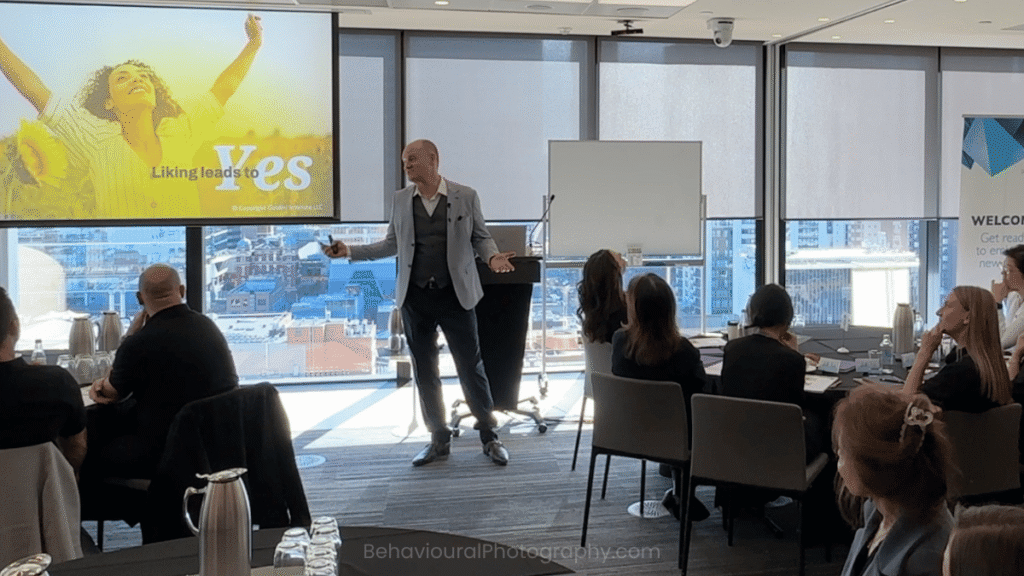
Since 2000, I have studied, taught and applied the science of human decision-making and ethical persuasion. There is an extraordinary body of behavioural science available to help us understand why people say YES, why they hesitate, what builds trust, what creates uncertainty and what helps people confidently move towards a decision.
Much of the practical application of that knowledge naturally concentrates on words. We consider what we should say and write, how we should structure a request, which information should come first, how we can communicate expertise, and how we can demonstrate that other people, like our audience, have already made the same decision. We also consider how we can reduce uncertainty before asking someone to act.
These are enormously valuable questions, and I have spent a large part of my career teaching people how to answer them through keynote, workshops, course and working within organisations. But persuasion has never been only about words. Before someone reads your headline, studies your proposal or considers your carefully constructed argument, they may already have seen something. Before a word is even spoken or read, what they see can influence what happens next or if it is ‘game over’ straight away.
How Images Influence Decisions and Behaviour
Imagine arriving at the website of a business you have never dealt with before. Within seconds, the imagery begins telling you things. Perhaps you see a confident team working together, customers interacting happily with employees, an expert in a professional environment, or a product being used by someone who appears similar to you.
Alternatively, perhaps you see an empty office, a generic stock photograph, a person looking friendly but purposeless at the camera, or an image that unintentionally directs your attention away from the most important part of the page. Before you have consciously analysed very much at all, those images may already have influenced your impression of the organisation.
That should not be surprising. Human beings do not process every decision by carefully analysing all the available information. We frequently rely on fast, intuitive mental processes and useful shortcuts that help us navigate an extraordinarily complicated world and an increasingly stimulation-overloaded day. Visual information can provide the shortcuts our brain relies on more heavily than ever before.
An image can communicate expertise, demonstrate popularity, create familiarity or similarity, capture attention, direct the eye, evoke emotion, demonstrate behaviour and reduce uncertainty. Sometimes an image can do several of those jobs simultaneously. Sometimes, without anybody realising it, an image can do exactly the opposite and work against what we are trying to achieve.
Behavioural Photography and Ethical Persuasion
This is an important distinction. Behavioural Photography is not about creating deceptive images designed to trick people into doing something they otherwise would not want to do. That is not persuasion.
Ethical persuasion preserves choice. It helps truthful information and genuine value become easier for people to recognise. It can reduce unnecessary uncertainty and make it easier for someone to confidently say YES when saying YES is appropriate for them. Manipulation and coercion are different things.
The same ethical standard must apply to imagery. If an organisation genuinely has considerable expertise, an image can help communicate that expertise. If many people genuinely use and value a service, imagery can help make that Social Proof visible. If customers genuinely enjoy interacting with an organisation, photographs can communicate that experience.
Behavioural Photography is not about manufacturing evidence that does not exist. It is about becoming considerably more deliberate about the truthful visual information we make available that has psychological value. That matters because images influence people, to our advantage or disadvantage, whether we understand the psychology behind them or not.
The Missing Half of Persuasive Communication

This is where I believe an important gap exists. We have an enormous body of knowledge about behavioural science and human decision-making. We also have extraordinarily sophisticated knowledge about photography, videography, illustration, graphic design, advertising and visual communication. Yet comparatively little practical attention appears to have been given to systematically bringing those two worlds together.
There are countless books, courses and experts teaching people how to improve what they say and write. I am one of them :). There are also countless resources teaching people how to create better-looking images. But what about deliberately applying the science of human behaviour to determine which images should be created in the first place?
That is the territory Behavioural Photography explores. The opportunity also extends far beyond photographers. The principles can apply to videographers, designers, illustrators, cartoonists, marketers, web designers, graphic designers, advertising professionals and people using artificial intelligence to create imagery. The medium may change, but the behavioural question remains the same:
What do we want people to think, feel or do as a result of seeing this?
That question can change the brief, expand the work and save our clients’ success that would otherwise be wasted.
Why a Beautiful Image Can Still Underperform
This is perhaps one of the most important ideas for businesses and visual professionals to understand: an image does not have to be bad to be the wrong image.
It can be beautifully captured, perfectly exposed, wonderfully composed, creatively brilliant and entirely consistent with the client’s brand. It can satisfy every conventional measure of photographic quality and still substantially underperform another image that could reasonably have been created instead if we had only known the science.
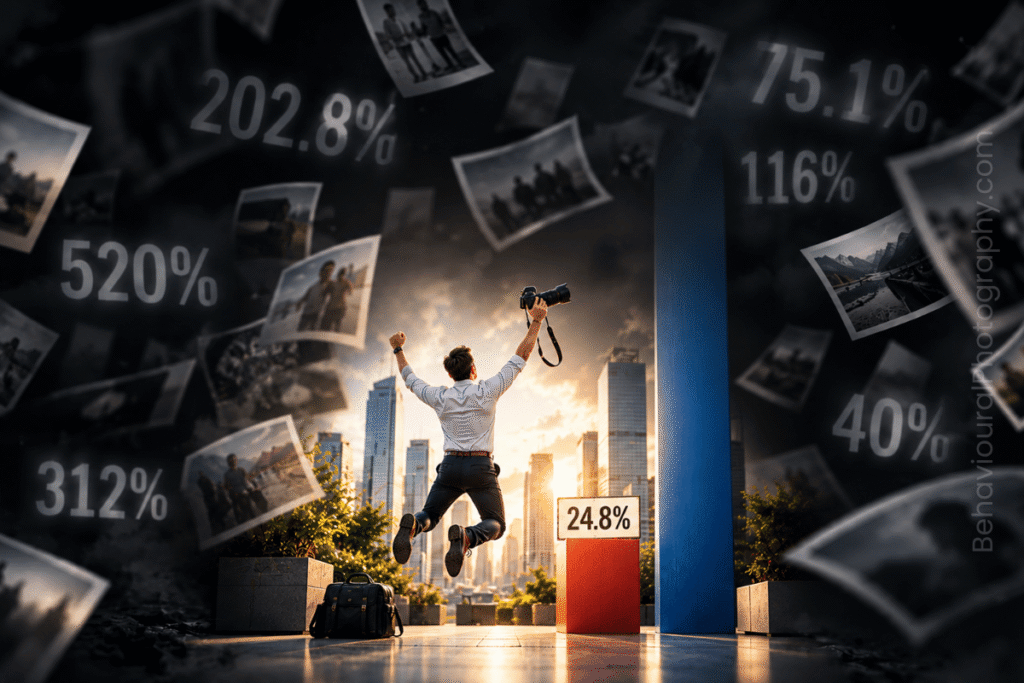
One photo produced 202.8% more of the desired behaviour than another.
One fascinating real-world experiment illustrates this beautifully. Researchers wanted to encourage people visiting a shopping centre to eat lunch before midday, thereby reducing pressure during the traditional lunchtime rush. They created posters carrying the same message but tested different imagery.
One version featured a single person eating lunch. It – The researchers, however, also tested a version showing a group of people eating lunch.
The first poster worked, increasing pre-noon food-court foot traffic by approximately 24.8% compared with displaying no poster. If you were the shopping centre—or the person responsible for the campaign—you would probably be delighted. A near 25% increase is a terrific result.
A second poster was tested. The wording and design remained the same, but it had a different photo. This version increased pre-noon food-court foot traffic by approximately 75.1% compared with displaying no poster. (Dobson, 2015)
Think about what that means. The first image worked and might have even delighted everyone involved, but the second worked dramatically better, or in other words, it recovered 66.9% of success that the clients was able to have if the photographer knew about the science of human decision-making and behaviour design. The second poster outperformed the first by 202.8%.
I hear you ask: “What photo was on the posters?”
The first poster depicted a person sitting in the food court enjoying lunch. Simple and straight forward. Now I ask you, and I hope you’ll take a moment to seriously consider this and test your own understanding: What image might the second photo have had to produce such a dramatically better result? Have a serious think about that now. What other image might you have created or recommended that would have worked so much better?
Did you come up with something? I’m going to tell you, and once I do, you won’t believe how simple it is. And once I’ve told it to you, then it’s easy, but before I revealed it, this might have been a real brain teaser that made you draw a blank. For those who know the science, this would have been easy. The second poster had a photo of multiple people enjoying lunch. That was it! – It visually activated the universal principle of social proof and amplified it by the presence of numerous people displaying the desired behaviour.
The issue was never simply whether the photograph was attractive; it was whether the visual information contained within it supported the behaviour the communication was intended to produce.
This demonstrates something fundamental about Behavioural Photography:
Every image has a job to do.

What Is a Business Really Buying When It Pays for Photography?
This leads us to another question that seems almost embarrassingly obvious once you ask it: what is a business actually buying when it commissions photographs, video or an illustration?
The answer is not photographs, video or an illustration. A charity commissioning campaign photography doesn’t ultimately want photographs; it wants more people to donate. A university commissioning photographs of its new campus wants prospective students to imagine themselves studying there and ultimately apply. A company investing in recruitment imagery wants suitable people to want to work there.

The same principle applies across almost every form of commercial visual communication:
- A retailer wants customers to understand, desire, trust and purchase its products.
- A professional services business wants prospective clients to feel sufficiently confident to make contact.
- A charity wants people to donate, volunteer or support its cause.
- An employer wants the right applicants to see themselves working within the organisation.
- A business introducing a new procedure wants employees to understand and follow it.
- A sales team needs imagery that can help prospective customers move confidently towards a decision.
The image is not the destination. The behavioural outcome is. This is why visual communication deserves to be approached differently. Instead of beginning only with What photographs does the client want?, we can begin with What does the client need these photographs to achieve?
That simple change in thinking forms one of the foundations of Behavioural Photography.
From Visual Creator to Behavioural Adviser
For people working in the visual industries, this creates what I believe is an extraordinary opportunity. Artificial intelligence is rapidly making it easier and cheaper to produce competent imagery. Technical excellence and creativity will continue to matter enormously, and Behavioural Photography is not intended to replace either of them. Instead, it adds another layer of expertise.
Imagine being able to sit with a client and go beyond discussing lighting, composition, location, clothing, colour and style. Instead, you begin discussing behaviour.
- What should prospective customers feel when they see these images?
- Where do people currently hesitate?
- Which photographs could strengthen trust?
- Where could we visually demonstrate expertise?
- Which images should the sales team have available that support the behaviours they depend on?
- What visual assets are missing from the organisation’s website, proposals, presentations, recruitment material or social media?
Suddenly, you are not merely waiting for a client to tell you what photographs they want. You are helping them discover the images they didn’t realise they needed.
You are moving from visual creator to behavioural adviser.
That has the potential to differentiate a visual professional’s business, increase the amount and breadth of work undertaken for existing clients, deepen those relationships and provide genuine reasons to remain involved over time. Most importantly, however, it enables the visual professional to do a better job for the client—not necessarily by producing a technically better photograph, but by producing an image better equipped to achieve the result for which the client commissioned it.
From Images to Persuasive Assets
This also changes the way we can think about the finished product. Instead of simply creating a collection of photographs, illustrations, graphics or video clips, we can deliberately create Persuasive Assets, with each asset intended to perform a particular behavioural function.
One asset might help establish credibility, while another reduces uncertainty. Another might communicate similarity and therefor increase liking, direct visual attention towards an important message, help someone imagine themselves experiencing an outcome, or make an unfamiliar process easier to understand. Over time, an organisation can build a library of visual assets capable of performing different behavioural jobs.

That is considerably more valuable than simply having a folder containing “some good photographs”. It also changes the commercial conversation around visual communication. When an image has a defined behavioural job and its contribution towards a business objective can be evaluated, it becomes easier to view professional imagery as an investment rather than simply a creative expense.
How Gaze Cueing Directs Visual Attention
Not every application requires a completely different photograph. Sometimes extraordinarily small visual differences can influence where people direct their attention.

One fascinating example is gaze cueing: our tendency to shift our attention in response to where another person is looking. A person within an image looking towards a headline, product or call to action may help direct the viewer’s attention towards it. Have that same person look somewhere else and the visual dynamics of the communication can change.
I’ve created a separate practical introduction to gaze cueing in visual communication, where you can experiment with this effect yourself. It is only one mechanism among many, but it demonstrates why behavioural thinking can become so valuable. Once you begin asking what an image is doing, rather than simply what it is showing, you start seeing visual communication differently.
Behavioural Photography Goes Beyond the Principles of Persuasion
Dr Robert Cialdini’s Principles of Persuasion are enormously important to Behavioural Photography, but the discipline is not simply about finding ways to express those principles in photographs or other visual communication. Visual communication can influence behaviour through a much broader range of psychological mechanisms.
Among the areas we can consider are:
- the direction and capture of attention
- the influence of emotion
- gaze cueing and visual direction
- body language and non-verbal cues
- emotional contagion
- familiarity
- contrast
- priming
- processing fluency
- the Principles of Persuasion, including Social Proof, Authority, Liking, Reciprocity, Consistency, Scarcity and Unity
There is considerably more to explore within each of these areas, and future articles on this website will examine these topics. Some will be written primarily for business owners and persuasion practitioners who want to become more deliberate about the imagery they use. Others will be particularly relevant to photographers, videographers, illustrators, designers and AI image creators who want to add behavioural science to their existing creative expertise.
The objective is not to replace the art of visual communication with science. It is to bring the two together. When an image is being created for a commercial purpose, looking good is rarely its only job.
Start With One Question
The next time you commission, create, select or generate an image, don’t begin only by asking whether it looks good. Instead, ask:
What behaviour do we want this image to support?
Then consider whether what you see within the image is helping it perform that job. That seemingly simple shift—from thinking about what an image should look like to thinking about what it should achieve—is where Behavioural Photography begins.
Continue Exploring Behavioural Photography
For a practical example of how human psychology can influence visual attention, explore our Lesson in Gaze Cueing
For a broader introduction to the science of human decision-making and ethical persuasion, visit Ethical Persuasion Training & Consulting.
For the research behind the shopping-centre example discussed above, read our lesson titled Show them others are already doing it